
2025 Subaru Forester vs. 2025 Honda CR-V in Ann Arbor, MI
2025 Subaru Forester vs 2025 Honda CRV
When exploring options for your next compact SUV, the 2025 Subaru Forester and the 2025 Honda CRV emerge as top contenders, offering a mix of reliability, performance, and advanced features that cater to a broad spectrum of drivers. Choosing the right vehicle can significantly enhance your driving experience, providing safety, comfort, and satisfaction on the road. As the automotive landscape continues to evolve, understanding the nuances between these two models becomes crucial for buyers seeking to make an informed decision that aligns with their lifestyle and needs.
Let's delve into a comprehensive comparison between the 2025 Subaru Forester and the 2025 Honda CRV, covering key aspects such as pricing, performance and specifications, interior and features, and ownership costs. Additionally, we'll explore why the 2025 Subaru Forester might be the preferred choice for some over the 2025 Honda CRV, providing you with the insight needed to determine which vehicle better suits your requirements. Whether you prioritize fuel efficiency, cabin space, or the latest in vehicular technology, this comparison aims to guide you through the decision-making process with detailed analysis and recommendations.
Pricing Overview: 2025 Subaru Forester vs 2025 Honda CRV
When purchasing a compact SUV, the initial cost is a crucial factor. In the 2025 models, the Subaru Forester and Honda CRV present competitive pricing, but with notable differences that might influence your decision.
MSRP Comparison: The 2025 Subaru Forester has a starting price of around $29,500, slightly less than the Honda CRV's starting price of around $30,000. This price advantage could be a deciding factor if you're looking for the most budget-friendly option.
Average Price Paid: While the exact average prices paid by consumers can vary, the starting MSRP provides a good indication of the overall market positioning of both vehicles. The Subaru Forester's lower starting price suggests that, on average, you may pay less compared to the Honda CRV, especially considering standard features included in the base model.
Invoice Cost: Invoice costs for these vehicles typically reflect a slight markup over the manufacturer's cost. For the Subaru Forester, the inclusion of standard all-wheel drive in every model adds significant value, considering that upgrading to all-wheel drive in the Honda CRV could push the price to nearly $33,000. This makes the Forester more affordable from a base price standpoint and offers better value when considering the cost of adding similar features to the CRV.
In summary, your choice between the 2025 Subaru Forester and the 2025 Honda CRV could largely depend on your budget and the value you place on features like all-wheel drive. The Forester offers a lower entry price and includes all-wheel drive as standard, presenting a strong value proposition right from the start.
Comparing Performance and Specifications: 2025 Subaru Forester vs 2025 Honda CRV
When comparing the performance and specifications of the 2025 Subaru Forester and the 2025 Honda CRV, several key factors may influence your decision based on your driving needs and preferences.
Engine Power and Torque: The 2025 Subaru Forester is equipped with a 2.5-liter flat-4 engine, delivering 182 horsepower at 5,800 rpm and 176 lb-ft of torque at 4,400 rpm. This engine design offers a lower center of gravity due to the Boxer engine design, enhancing vehicle stability. On the other hand, the 2025 Honda CRV features a 1.5-liter inline-4 engine, which produces a slightly higher 190 horsepower at 6,000 rpm and 179 lb-ft of torque at 1,700 rpm. The higher torque at lower rpm may be attractive if you prefer quicker acceleration from a stop.
Transmission and Drivetrain: Both vehicles come with a continuously variable-speed automatic transmission, ensuring smooth ride quality and efficient power delivery. The Subaru Forester stands out with its standard all-wheel drive across all models, providing enhanced traction and control in various driving conditions. In contrast, the Honda CRV starts with a front-wheel-drive setup, with all-wheel drive available as an upgrade. This could be a crucial factor if you frequently drive in bad weather or on challenging terrains.
Fuel Economy: Fuel efficiency is another important aspect to consider. The Subaru Forester offers an EPA estimated fuel economy of 26 MPG in the city and 33 MPG on the highway, with a combined efficiency of 29 MPG. It also features a larger fuel capacity of 16.6 gallons, which extends its driving range to 432 miles in the city and 548 miles on the highway. The Honda CRV slightly edges out with a fuel economy of 28 MPG in the city, 34 MPG on the highway, and a combined 30 MPG. However, it has a smaller 14.0-gallon fuel tank, resulting in a driving range of 392 miles in the city and 476 miles on the highway.
These specifications highlight the strengths of each vehicle, with the Subaru Forester excelling in drivetrain and stability, and the Honda CRV offering slightly better fuel efficiency and engine power. Your choice may depend on what aspects of vehicle performance are most important to your driving experience.
2025 Subaru Forester vs 2025 Honda CRV: Interior Features and Comfort
Seating Capacity and Comfort: In the 2025 Subaru Forester, you and your passengers can enjoy a spacious cabin that offers ample room with a seating capacity of five. The Forester provides generous dimensions including a front headroom of 41.2 inches, front legroom of 43.3 inches, and front shoulder room of 58.1 inches. In the rear, there's a headroom of 39.6 inches, legroom of 39.4 inches, and shoulder room of 57.2 inches. The seats come standard with cloth upholstery, and for those colder days, heated seats are available in other styles. The rear seats also have a standard folding capability, enhancing the flexibility and cargo space, which totals up to 76.1 cubic feet with the seats down.
Technology and Entertainment: The 2025 Subaru Forester features the STARLINK® Multimedia system, which integrates seamlessly with Apple CarPlay and Android Auto, providing easy access to navigation, music, and more while on the go. For an enhanced auditory experience, the Forester offers an available Harman Kardon® premium audio system. Standard tech features include Bluetooth connectivity, while satellite radio and keyless ignition are available on other styles. Additionally, the panoramic moonroof enhances the sense of space and offers a fantastic view, making every drive more enjoyable.
Safety Features: Safety is paramount in the 2025 Subaru Forester, which comes standard with EyeSight® Driver Assist Technology. This suite includes Adaptive Cruise Control, Lane Keep Assist, and Pre-Collision Braking, aimed at keeping you safe on the road. The Forester also features the innovative DriverFocus® Distraction Mitigation System, designed to help maintain your attention while driving. With these technologies, along with a Top Safety Pick+ rating from the IIHS, the Forester stands out as one of the safest SUVs in its class. Additional safety features include a comprehensive airbag system, electronic stability control, and a suite of advanced driver aids like Blind Spot Monitor and Lane Departure Warning to enhance your driving confidence.
Wrapping Up: Which One Fits Your Needs – 2025 Subaru Forester or 2025 Honda CRV
If you're considering a compact SUV and find yourself comparing the 2025 Subaru Forester with the 2025 Honda CRV, there are several compelling reasons to opt for the Subaru Forester. Here's a breakdown of why it might be the better choice for your needs:
- 1. Superior All-Wheel Drive System: Every model of the Subaru Forester comes standard with Symmetrical All-Wheel Drive. This system enhances traction and stability by distributing power evenly to all four wheels and adjusting to maintain grip in slippery conditions. In contrast, the Honda CRV starts with a standard front-wheel drive, and all-wheel drive is only available at an additional cost.
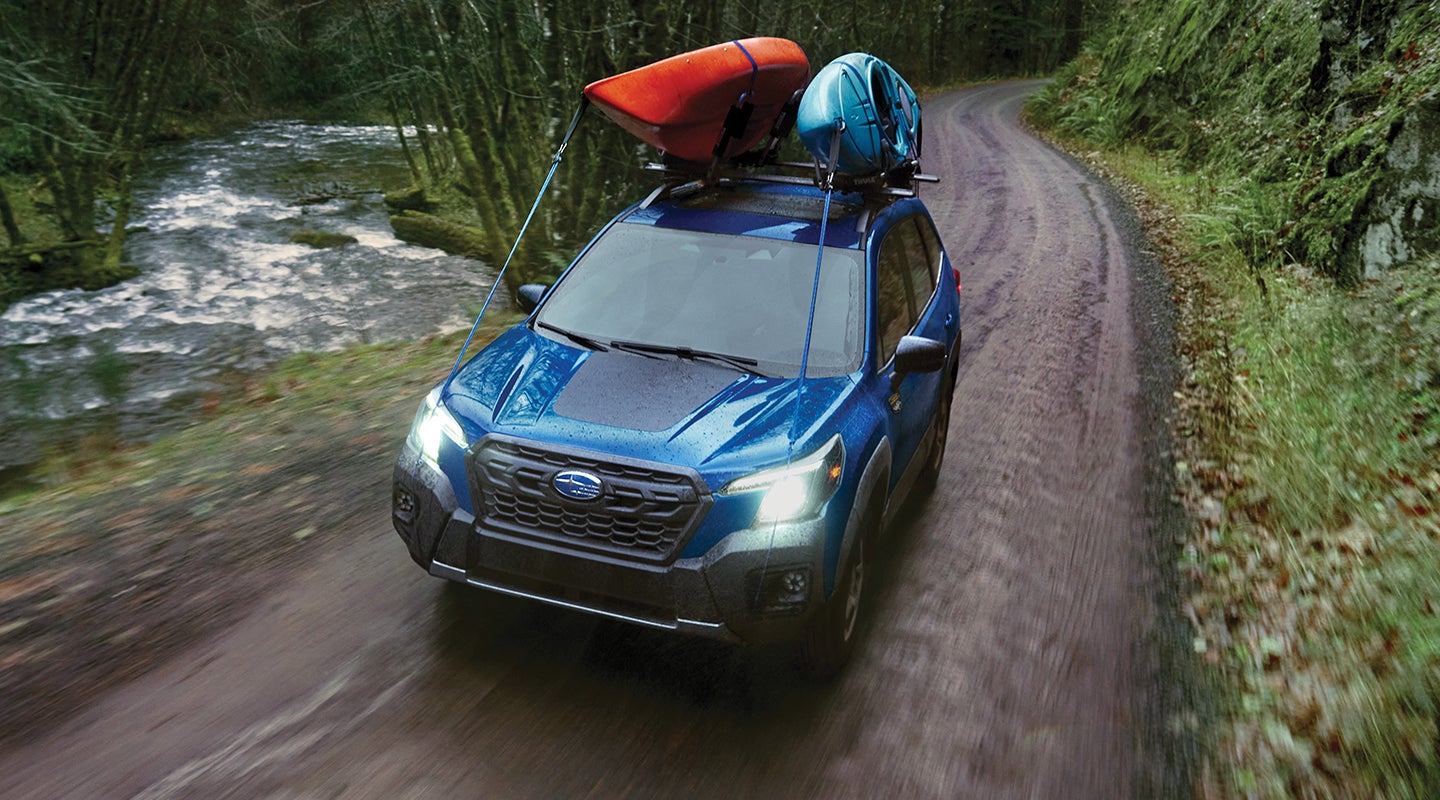
- 2. Off-Road Capability: The Subaru Forester is equipped for both city and highway driving and excels off-road. The Forester Wilderness model, in particular, is designed to handle tough terrain with features like 9.2-inches of ground clearance, all-terrain tires, and skid plates. This makes the Forester a versatile choice if you enjoy outdoor adventures. The Honda CRV, while capable, does not offer a comparable model specifically geared for off-road performance.
- 3. Spacious and Comfortable Interior: The Subaru Forester offers a more spacious cabin with 111.9 cubic feet of passenger volume, allowing both front and rear passengers to enjoy greater comfort and space. This compares favorably to the Honda CRV, which has 105.9 cubic feet of passenger volume, potentially making it feel more cramped, especially in the rear seats.
- 4. Advanced Safety Features: Safety is paramount in the Subaru Forester, which includes the EyeSight® Driver Assist Technology as standard. This suite of features, such as Adaptive Cruise Control and Pre-Collision Braking, helps enhance your safety on the road. While the Honda CRV also offers advanced safety features, the Subaru Forester's additional DriverFocus® Distraction Mitigation System further contributes to safe driving by monitoring driver attention.
- 5. Cost-Effectiveness: The starting price of the Subaru Forester is slightly lower than that of the Honda CRV, and when you consider the inclusion of all-wheel drive as a standard feature, the Forester presents a more economical option without the need for upgrades.
- 6. Enhanced Visibility: The Subaru Forester features LED steering-responsive headlights as standard, which illuminate the road effectively and adjust the direction of light based on steering input, providing better visibility around corners. While the Honda CRV offers a similar feature, it is not standard across all models.
Choosing the 2025 Subaru Forester could be a wise decision if you value robust all-weather capability, off-road readiness, spacious interiors, and advanced safety features, all at a competitive price point.